

Bottlenecks: One of the Hidden Budget Busters in Physical Work
Bottlenecks: One of the Hidden Budget Busters in Physical Work
Most bottlenecks on a project don’t look like major problems.
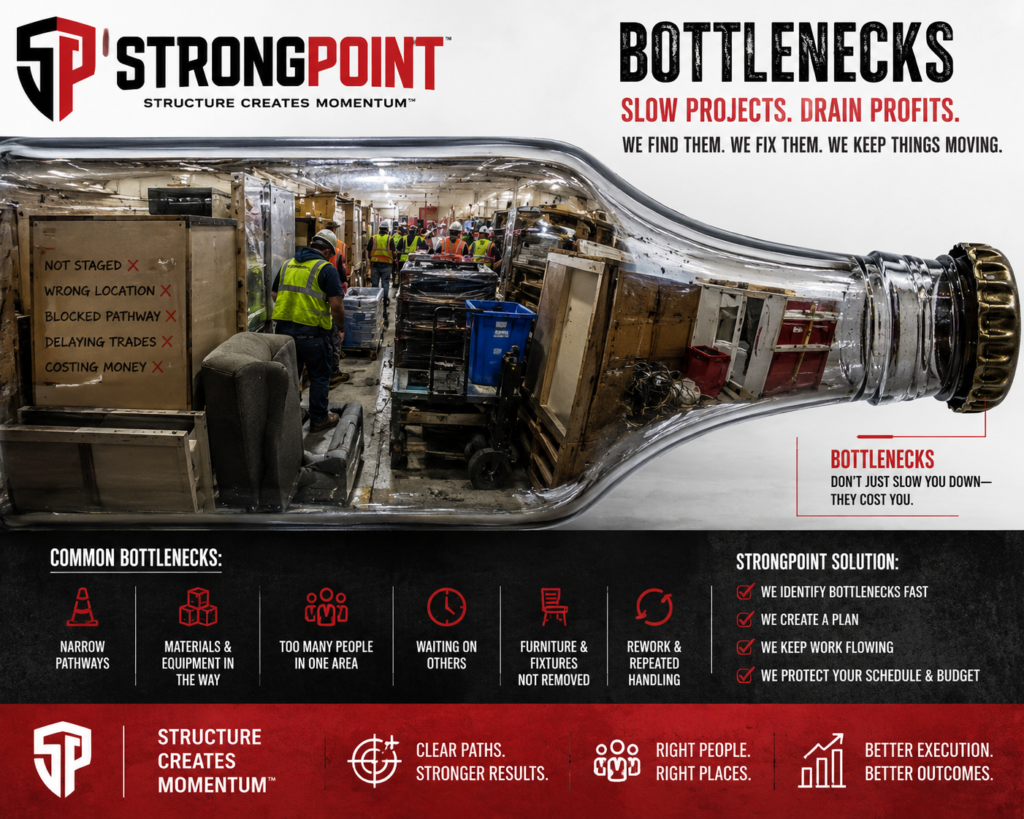
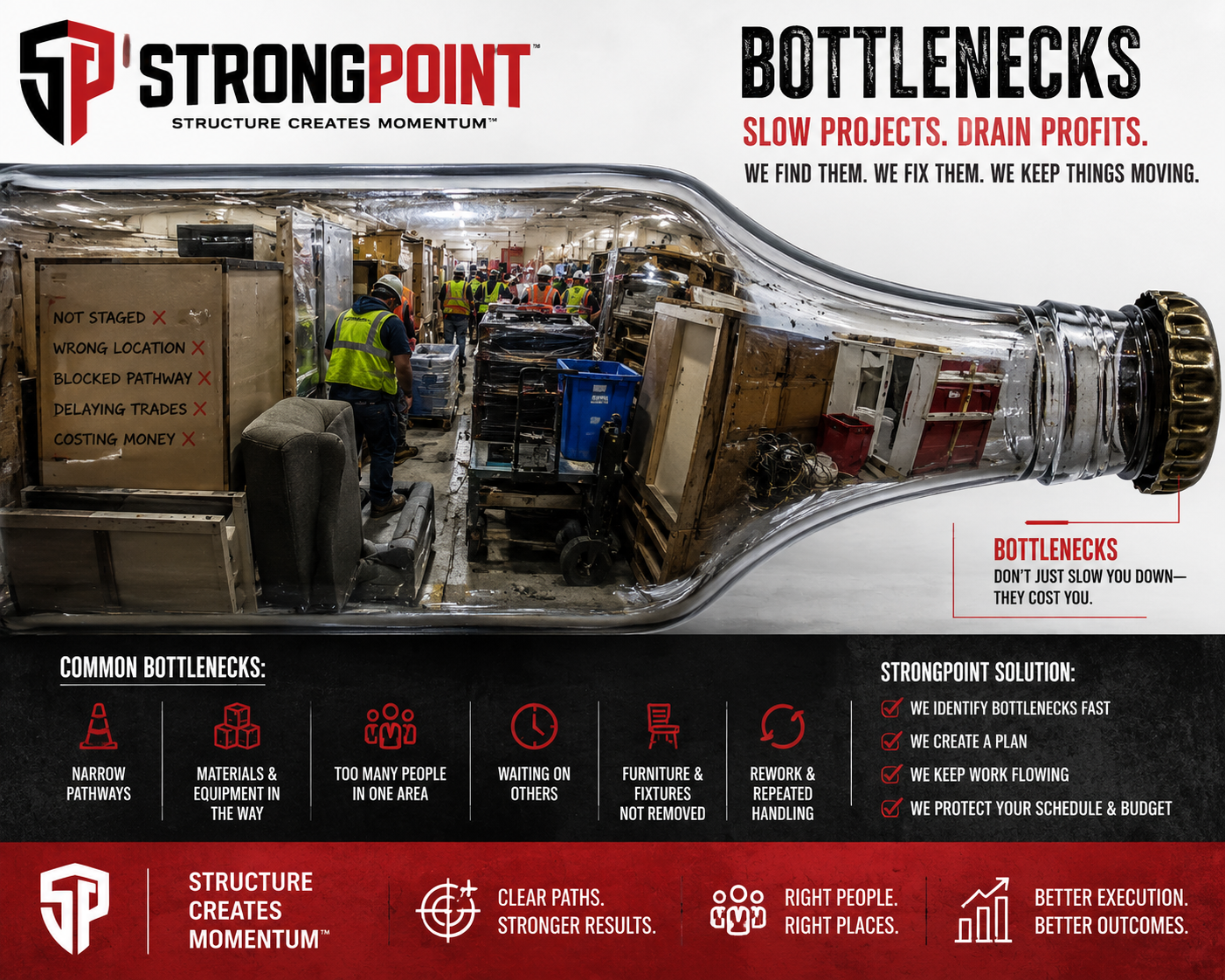
Sometimes it’s a narrow pathway. Sometimes it’s furniture, fixtures, materials, or equipment sitting where people need to work. Sometimes there are simply too many people packed into the same area, getting in each other’s way.
And sometimes the bottleneck is a crew that started the morning moving strong but gradually slows down as the day wears on.
Individually, these things may not look like much. Stack enough of them together, though, and they start eating away at productivity, schedules, and ultimately the project budget.
That’s why at StrongPoint, we pay attention to bottlenecks.
Small Bottlenecks Can Create Big Problems
Think about a project like traffic on the highway.
Everything can be moving just fine until one lane gets blocked. Then people start slowing down, backing up, waiting, and trying to work around one another.
A job site isn’t much different.
A poorly placed fixture blocks a pathway. One crew has to wait for another crew to finish. Materials get staged in the wrong place. Something gets moved once, then moved again, and maybe moved a third time.
Before long, you’ve got people standing around, vendors getting irritated, schedules slipping, and money being burned.
The problem isn’t always that people aren’t working hard.
Sometimes the work itself is clogged up.
We Look for What’s Slowing the Job Down
StrongPoint’s Project Lead is constantly asking two simple questions:
What’s slowing us down?
What can we do to keep things moving?
That’s a different mindset from simply telling people to work harder.
When part of your job is identifying bottlenecks, you get pretty good at seeing them. You begin noticing little things other people may walk right past.
To the naked eye, a project might look like it’s running just fine.
We look closer.
Can that pathway be opened up?
Can those materials be staged somewhere better?
Are we handling something twice that should only be handled once?
Are too many people working in the same space?
Is one part of the operation waiting on another?
Is the crew slowing down because the workflow is wearing them out?
Where is the bottleneck?
And once we find it, how do we get it out of the way?
Preventing Bottlenecks Starts With the Walkthrough
The best time to deal with a bottleneck is before it ever becomes one.
That’s why one of the most important parts of the StrongPoint process is the initial walkthrough.
Before the work gets rolling, we look at pathways, staging areas, furniture, fixtures, equipment, loading points, vendor work areas, potential obstructions, and the sequence in which the work needs to happen.
We want a plan from the get-go.
Because once everybody is working, that’s not the time to discover that three crews need the same hallway or that somebody stacked materials directly in the path of the next phase of work.
A little thinking on the front end can prevent a whole lot of wasted time on the back end.
More People Doesn’t Always Mean More Speed
One of the oldest responses to a slow project is:
“Throw more people at it.”
But more people don’t automatically make a project move faster.
Put too many people into a limited workspace and you can create another bottleneck. People start crossing paths, waiting on one another, duplicating work, and getting in each other’s way.
Now you’re paying for more manpower while getting less production per person.
StrongPoint takes a different approach.
We don’t simply tell our people to work harder.
We give them structure so they can work smarter.
Defined responsibilities. Clear pathways. Organized staging. Proper sequencing. Less repeated handling. Better communication.
The goal isn’t running people into the ground.
The goal is removing as much unnecessary friction from their work as possible.
The Job Can Always Run Better
That’s part of the StrongPoint mindset.
We don’t look at a project and say, “Well, everybody’s busy, so everything must be working.”
Being busy and being productive aren’t always the same thing.
We keep looking.
Where’s the next bottleneck?
What’s getting clogged up?
What’s causing unnecessary movement?
Where are we losing minutes?
What can we change right now to keep the project rolling?
Because five minutes wasted here and ten minutes wasted there may not look like much.
But multiply those little delays across several people, several vendors, and an entire workday, and suddenly those minutes turn into hours—and those hours turn into dollars.
That’s why StrongPoint believes better physical execution isn’t about working people harder.
It’s about organizing the work better.
Structure Creates Momentum™.
And at StrongPoint, we work that philosophy from the first walkthrough until the project is finished.