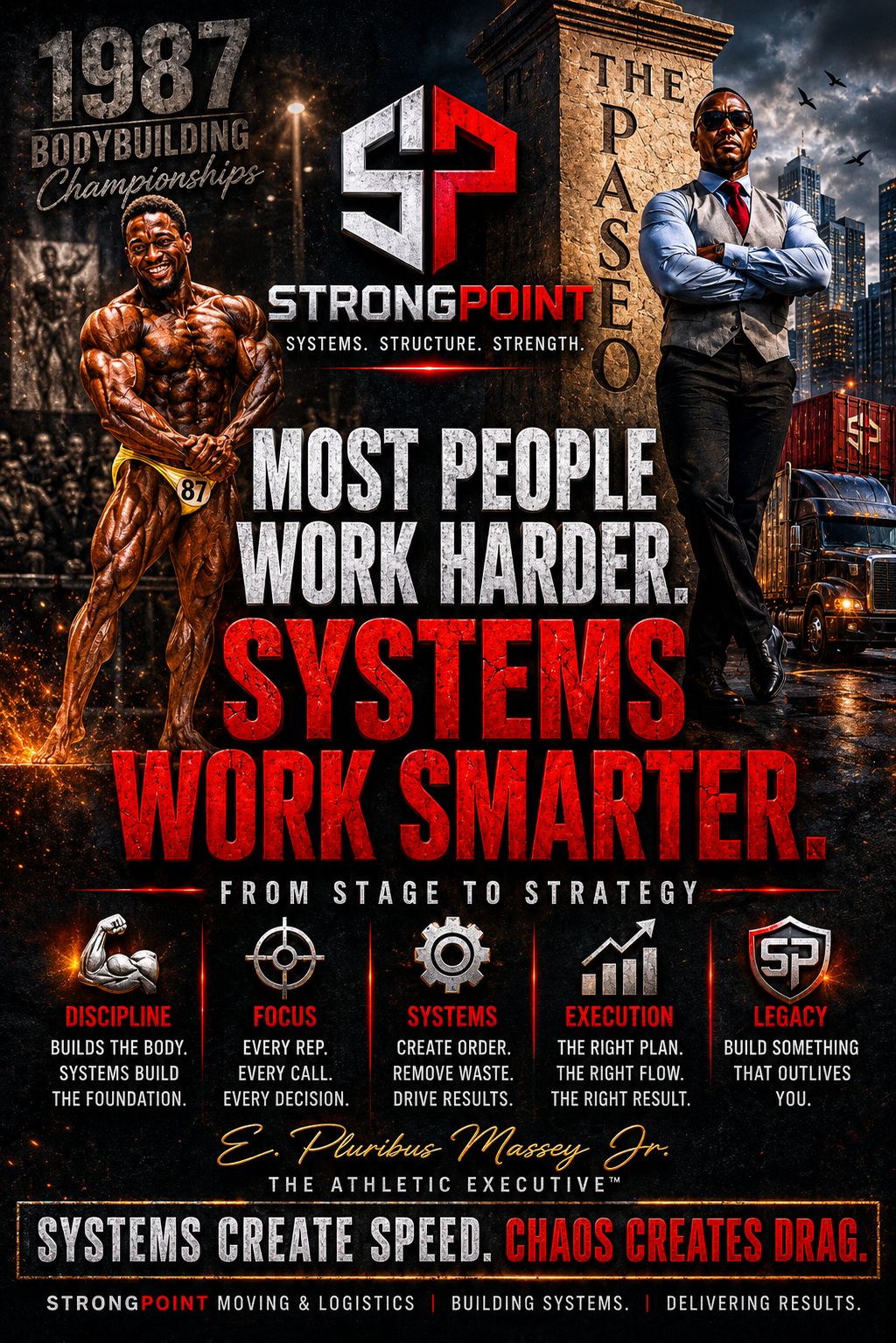
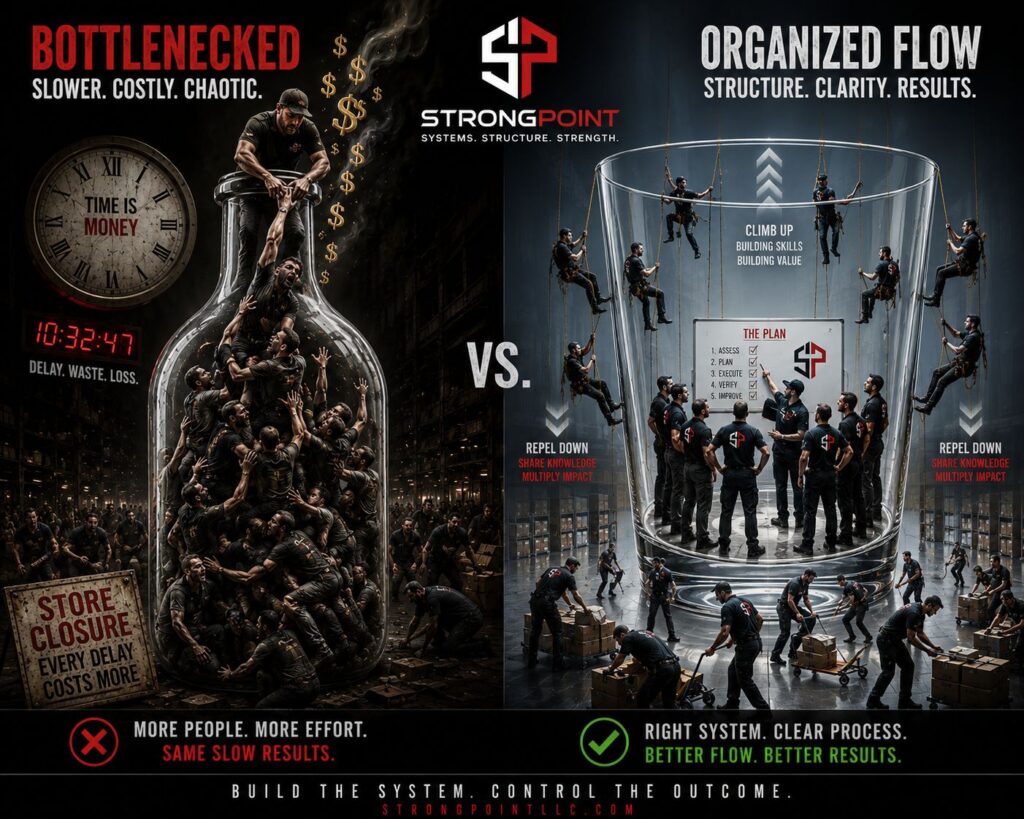
The problem is that most people never define what working smarter actually means. At 24 years old, I learned that speed does not come from doing more. It comes from having a system. As a competitive bodybuilder, every exercise had a purpose. Every set, every repetition, every meal, and every recovery day was part of a larger structure. The goal was not to spend the most time in the gym. The goal was to get the best result from the time invested. While some trained for hours, I learned that precision often beats volume. The system created the speed. Looking back, bodybuilding taught me something much bigger than fitness. It taught me how to think. Today, I apply the same principles to business. Many organizations assume that when a project slows down, the answer is more manpower. Sometimes the opposite is true. More people without structure can create congestion, confusion, repeated handling, and wasted payroll. The solution is not always more effort. The solution is often better flow. The right sequence. The right staging. The right movement. The right execution. When people, equipment, and tasks move through a structured process, projects move faster, budgets are protected, and results improve. Whether building a physique, running a company, or executing a commercial project, the lesson remains the same: Hard work is essential. Systems determine how far that hard work can take you. E. Pluribus Massey Jr. The Athletic Executive™
Most project slowdowns are not caused by a lack of manpower.
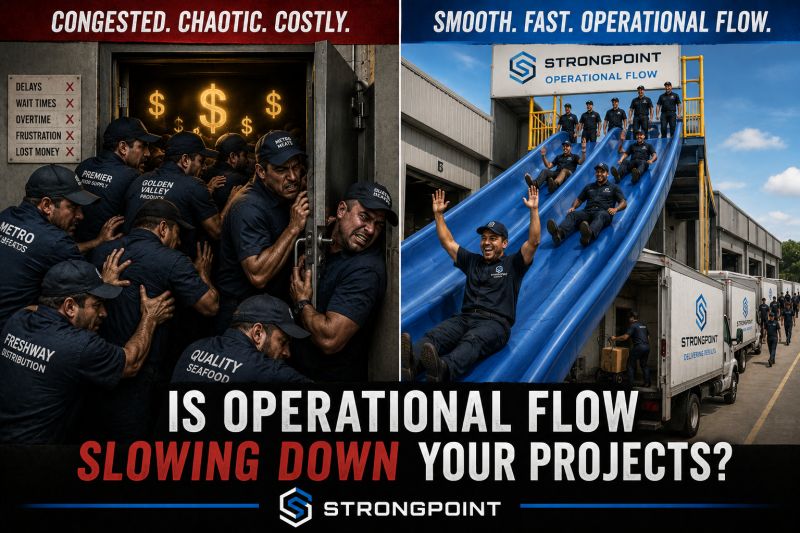
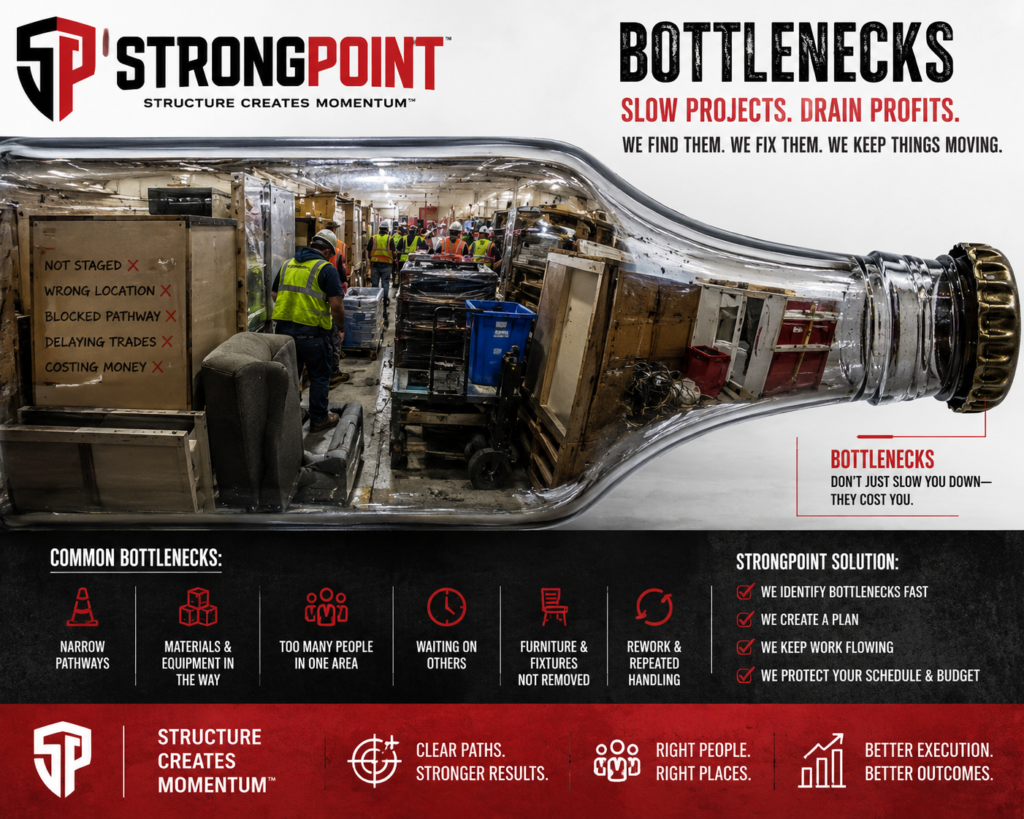
They are caused by poor operational flow. When crews, vendors, trucks, and equipment are not organized, projects slow down fast. You see it every day: • crews waiting • blocked exits • trucks sitting still • vendors stacked on top of each other • payroll burning while movement stops Every bottleneck costs money: • delays • overtime • confusion • wasted movement • slower project completion The problem is not movement. The problem is uncontrolled movement. StrongPoint helps create structured operational flow to keep projects moving with less congestion and less wasted time. That means: • organized staging • controlled movement • better vendor flow • faster throughput • quicker project turnover Systems create movement. Movement creates speed. Speed protects profit. — EPluribus Massey Jr. The Athletic Executive™ StrongPoint Moving & Logistics LLC
If you underestimate organized, systemized manpower, you are underestimating how much closures, transitions, renovations, liquidations, and commercial projects truly cost.
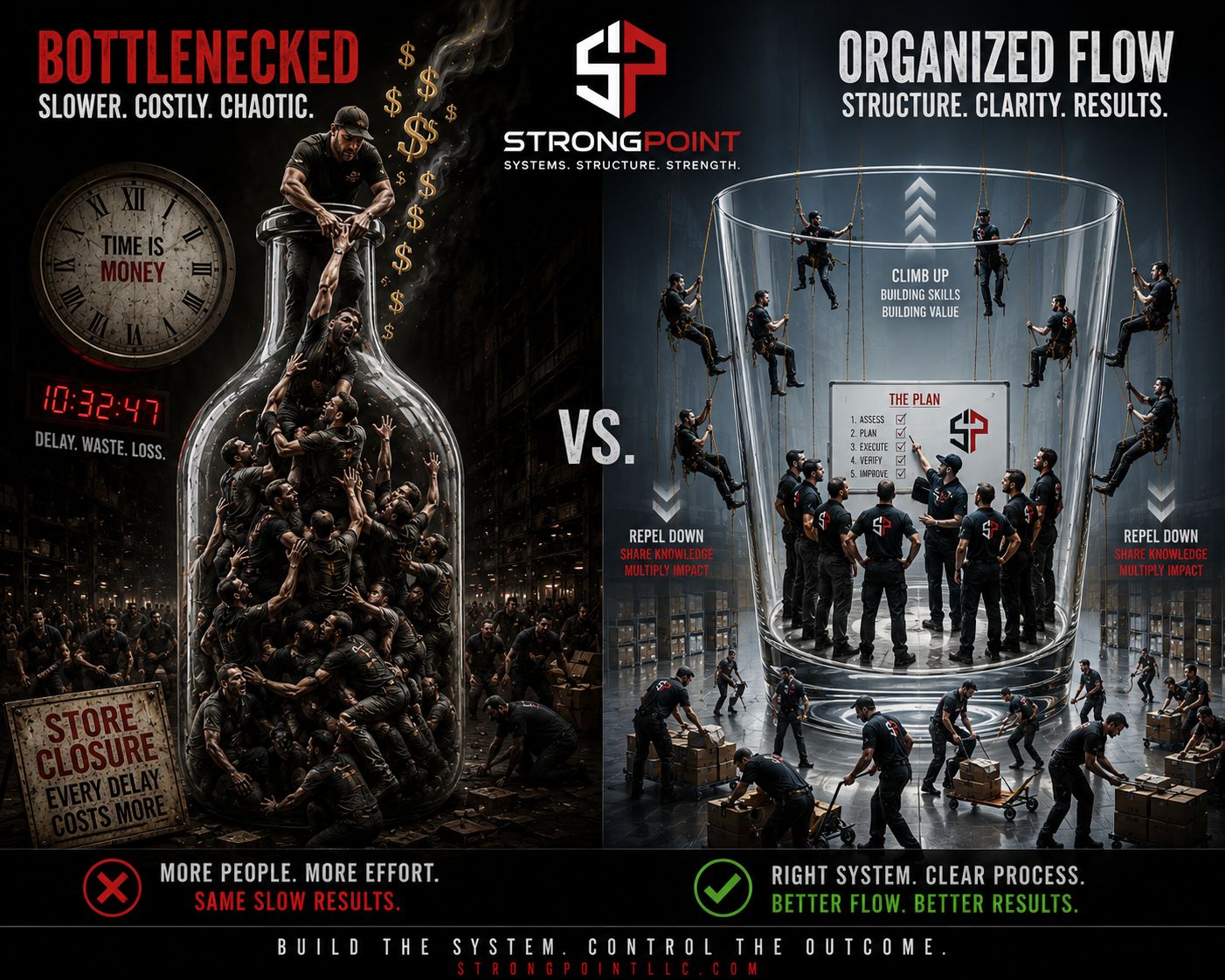
Most projects do not lose money from lack of effort. They lose money from bottlenecks, repeated handling, blocked movement, poor staging, confusion, and labor working against itself instead of through a controlled process.
Chaos slows everything down.
At StrongPoint, we focus on eliminating the bottlenecks that quietly destroy speed, payroll efficiency, and operational flow.
We walk in with a system mindset first. We assess the landscape, organize the movement, structure the labor flow, and customize execution around the environment and objectives of the project.
The goal is simple: Create continuous movement without operational congestion.
When labor flows with structure instead of disorder, projects move faster with less stress, less wasted movement, fewer interruptions, and better use of manpower.
Organized systems create momentum.
Eliminate the bottleneck and the entire operation begins to move with greater speed, control, clarity, and efficiency. The difference eventually shows up in the timeline, the labor costs, and the final project outcome.
— The Athletic Executive™ EPluribus Massey Jr. StrongPoint.
Systems reduce confusion, wasted movement, and constant trial and error. Without a planned path, people repeat the same actions over and over without correcting mistakes or improving the process. Eventually the operation controls them instead of them controlling the operation. The first goal in any new role, business, or major project is to build a system. A step-by-step process that can be followed, repeated, measured, improved, and scaled over time. When handling closures, transitions, or decommissions, you do not walk in hoping things work out. You walk in with a system. Systems expose problems early, reduce costly mistakes, improve movement, and create operational control over both the visible and invisible issues that destroy time and money.
Bottlenecks: One of the Hidden Budget Busters in Physical Work
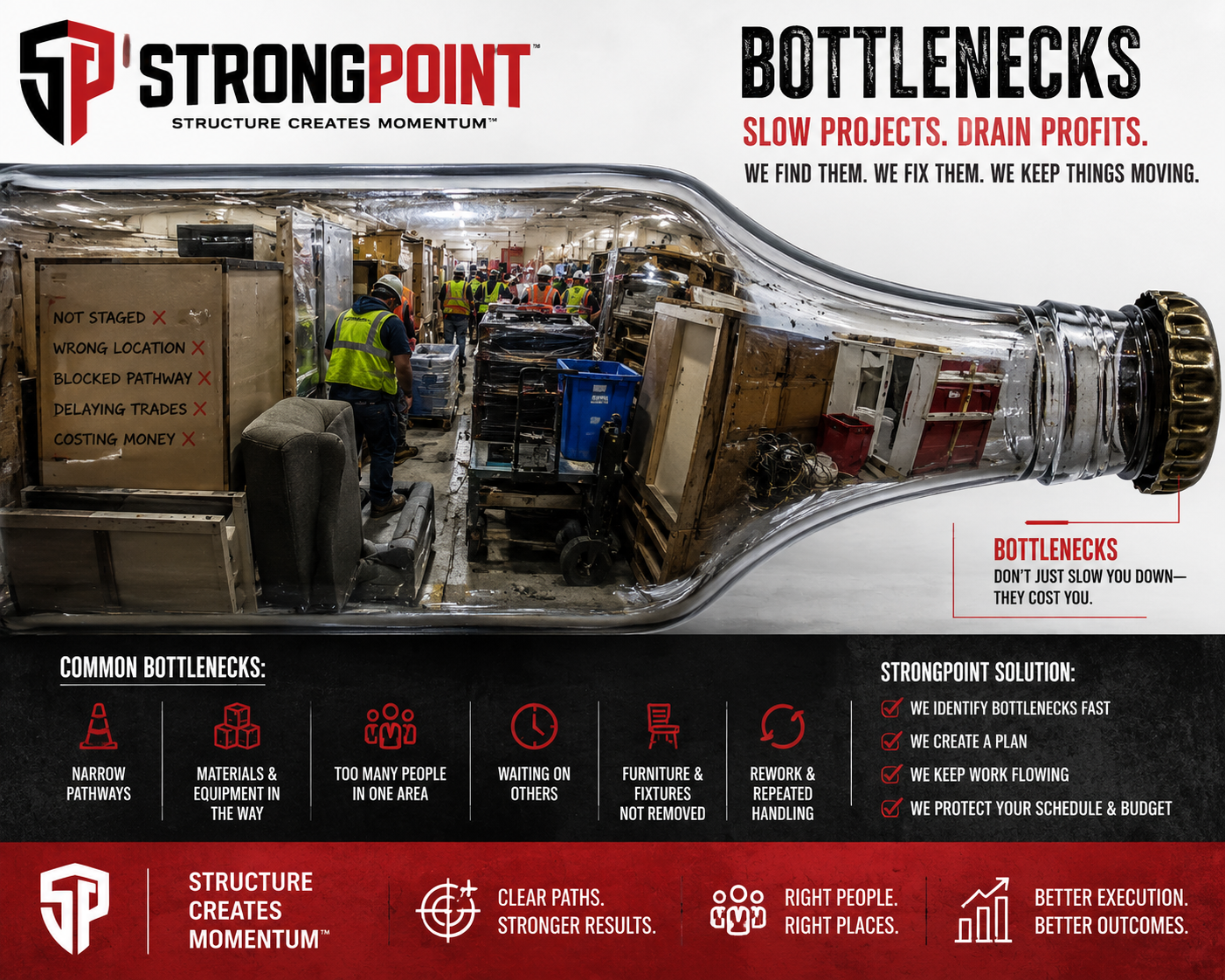
Most bottlenecks on a project don’t look like major problems.
Sometimes it’s a narrow pathway. Sometimes it’s furniture, fixtures, materials, or equipment sitting where people need to work. Sometimes there are simply too many people packed into the same area, getting in each other’s way.
And sometimes the bottleneck is a crew that started the morning moving strong but gradually slows down as the day wears on.
Individually, these things may not look like much. Stack enough of them together, though, and they start eating away at productivity, schedules, and ultimately the project budget.
That’s why at StrongPoint, we pay attention to bottlenecks.
Small Bottlenecks Can Create Big Problems
Think about a project like traffic on the highway.
Everything can be moving just fine until one lane gets blocked. Then people start slowing down, backing up, waiting, and trying to work around one another.
A job site isn’t much different.
A poorly placed fixture blocks a pathway. One crew has to wait for another crew to finish. Materials get staged in the wrong place. Something gets moved once, then moved again, and maybe moved a third time.
Before long, you’ve got people standing around, vendors getting irritated, schedules slipping, and money being burned.
The problem isn’t always that people aren’t working hard.
Sometimes the work itself is clogged up.
We Look for What’s Slowing the Job Down
StrongPoint’s Project Lead is constantly asking two simple questions:
What’s slowing us down?
What can we do to keep things moving?
That’s a different mindset from simply telling people to work harder.
When part of your job is identifying bottlenecks, you get pretty good at seeing them. You begin noticing little things other people may walk right past.
To the naked eye, a project might look like it’s running just fine.
We look closer.
Can that pathway be opened up?
Can those materials be staged somewhere better?
Are we handling something twice that should only be handled once?
Are too many people working in the same space?
Is one part of the operation waiting on another?
Is the crew slowing down because the workflow is wearing them out?
Where is the bottleneck?
And once we find it, how do we get it out of the way?
Preventing Bottlenecks Starts With the Walkthrough
The best time to deal with a bottleneck is before it ever becomes one.
That’s why one of the most important parts of the StrongPoint process is the initial walkthrough.
Before the work gets rolling, we look at pathways, staging areas, furniture, fixtures, equipment, loading points, vendor work areas, potential obstructions, and the sequence in which the work needs to happen.
We want a plan from the get-go.
Because once everybody is working, that’s not the time to discover that three crews need the same hallway or that somebody stacked materials directly in the path of the next phase of work.
A little thinking on the front end can prevent a whole lot of wasted time on the back end.
More People Doesn’t Always Mean More Speed
One of the oldest responses to a slow project is:
“Throw more people at it.”
But more people don’t automatically make a project move faster.
Put too many people into a limited workspace and you can create another bottleneck. People start crossing paths, waiting on one another, duplicating work, and getting in each other’s way.
Now you’re paying for more manpower while getting less production per person.
StrongPoint takes a different approach.
We don’t simply tell our people to work harder.
We give them structure so they can work smarter.
Defined responsibilities. Clear pathways. Organized staging. Proper sequencing. Less repeated handling. Better communication.
The goal isn’t running people into the ground.
The goal is removing as much unnecessary friction from their work as possible.
The Job Can Always Run Better
That’s part of the StrongPoint mindset.
We don’t look at a project and say, “Well, everybody’s busy, so everything must be working.”
Being busy and being productive aren’t always the same thing.
We keep looking.
Where’s the next bottleneck?
What’s getting clogged up?
What’s causing unnecessary movement?
Where are we losing minutes?
What can we change right now to keep the project rolling?
Because five minutes wasted here and ten minutes wasted there may not look like much.
But multiply those little delays across several people, several vendors, and an entire workday, and suddenly those minutes turn into hours—and those hours turn into dollars.
That’s why StrongPoint believes better physical execution isn’t about working people harder.
It’s about organizing the work better.
Structure Creates Momentum™.
And at StrongPoint, we work that philosophy from the first walkthrough until the project is finished.
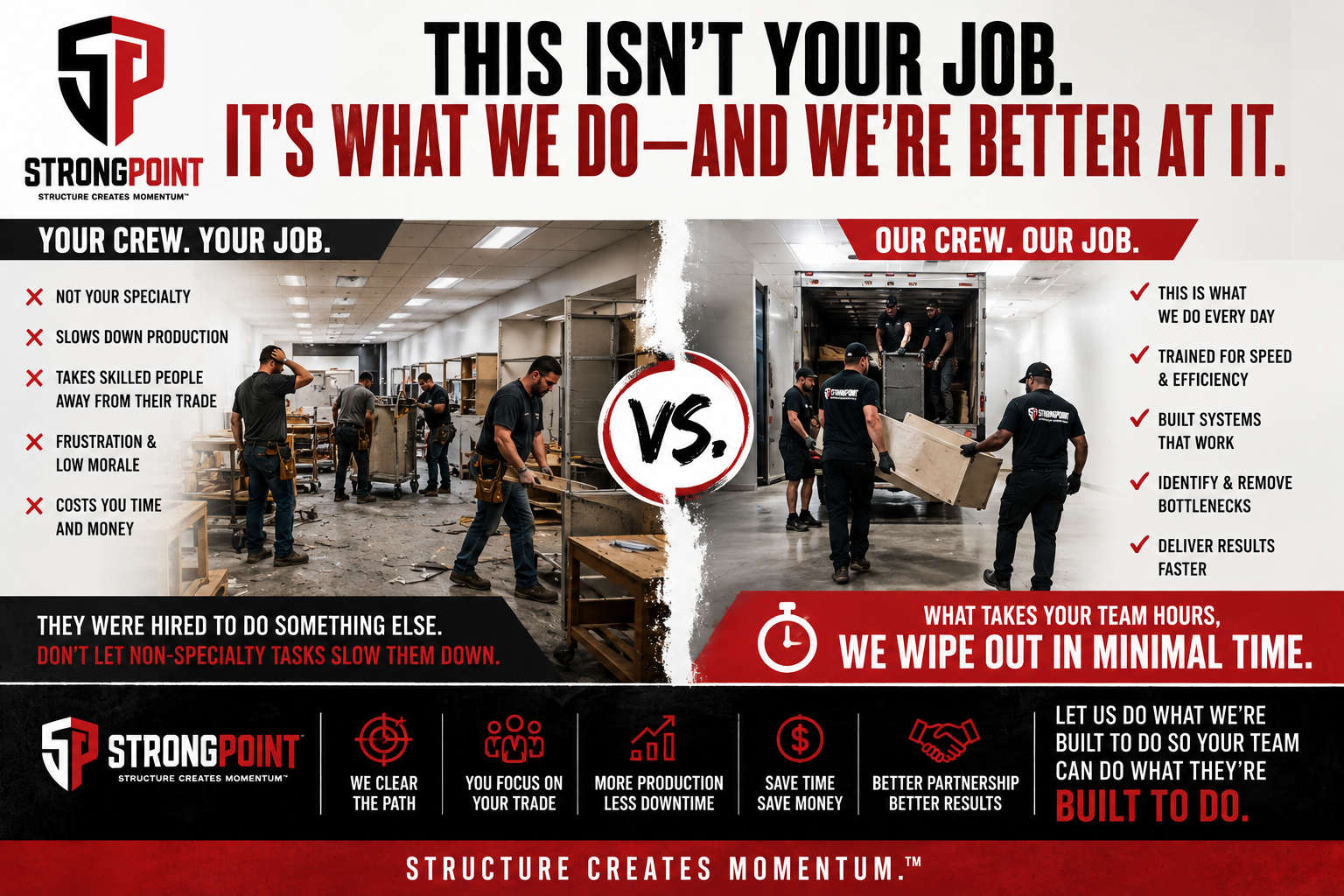
This Isn’t Your Job. It’s What We Do, And We’re Better at It.
We hear it all the time:
“We already have a crew that can handle that.”
And they’re probably right.
A flooring company has installers. A property management company has maintenance technicians. A contractor has a crew. A facility has its own people.
They can move furniture, remove fixtures, clear work areas, stage materials, haul equipment, and prepare spaces.
But here’s the question:
Should they?
Your People Were Hired for Something Else
A flooring installer came to work to install floors.
A maintenance technician came to work to maintain and troubleshoot buildings.
An electrician came to work to perform electrical work.
When you pull those people away from what they specialize in and tell them to spend hours moving furniture, clearing rooms, breaking down fixtures, carrying materials, or preparing a site, you’re asking them to do work they probably don’t want to do—and work they don’t do every day.
That matters.
When somebody views a task as “not really my job,” there’s naturally less enthusiasm for it.
They’ll get it done.
But there’s a difference between getting something done and being built to do it.
Our People Know What They Signed Up For
StrongPoint is different.
Our people looked at the job description before they applied.
They came into the interview knowing what kind of work we do.
They understand that moving, clearing, staging, removing, loading, organizing, and physically preparing commercial spaces is the job.
There’s no surprise.
There’s no:
“Why are we doing this?”
There’s no:
“This isn’t what I was hired for.”
This is exactly what our people were hired for.
And that creates a completely different mindset.
Repetition Creates Speed
There’s another big difference:
We do this over and over again.
Your flooring installer might move furniture every once in a while.
Your maintenance crew might clear a commercial space when the need comes up.
Our people perform these types of physical tasks repeatedly.
That repetition matters.
When somebody performs the same types of tasks multiple times a day and dozens of times over the course of weeks, they begin seeing the work differently.
They recognize bottlenecks.
They understand staging.
They learn how to clear pathways.
They anticipate what needs to move next.
They reduce unnecessary handling.
They know when something should go directly to its final destination instead of being set down somewhere just to be picked up again later.
Repetition develops efficiency.
Then we put StrongPoint’s systems and structure behind that repetition.
That’s where speed comes from.
It’s Not That Your Crew Can’t Do It
This is important.
We’re not saying your people aren’t capable.
We’re saying their time is more valuable somewhere else.
What might take your specialized crew several hours to work through may take an organized StrongPoint crew considerably less time because it’s what we’re prepared, structured, and trained to do.
That’s not a knock against your people.
It’s specialization.
You wouldn’t hire StrongPoint to install flooring.
You wouldn’t hire us to troubleshoot an HVAC system.
You wouldn’t hire us to wire a building.
Those aren’t our specialties.
So why take the people who are specialists in those areas and have them spend valuable production time doing ours?
Let Your People Do What They Came to Do
That’s the StrongPoint proposition.
Let us do what we’re built to do so your people can do what they’re built to do.
Your installers install.
Your technicians troubleshoot.
Your contractors build.
Your maintenance team maintains.
StrongPoint clears the path so they can get to work.
That can mean less downtime, less frustration, better use of skilled people, and more productive hours spent doing the work that actually generates revenue for your company.
And there’s another potential benefit.
If we’re taking the physical preparation, clearing, staging, and transition work off your team’s shoulders, you may have more capacity to take on the work you actually specialize in.
Instead of tying up skilled people doing work they don’t want to do, put them back on the work you’re paying them to be great at.